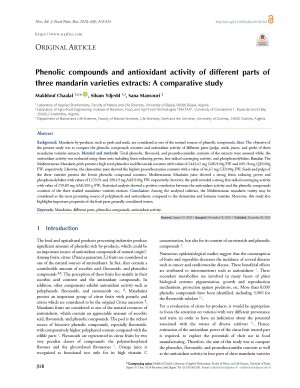
Phenolic Compounds and Antioxidant Activity of Different Parts of Three Mandarin Varieties Extracts: A Comparative Study
Copyright © 2020 Authors

This work is licensed under a Creative Commons Attribution 4.0 International License.
- Attribution — You must give appropriate credit, provide a link to the license, and indicate if changes were made.
- No additional restrictions — You may not apply legal terms or technological measures that legally restrict others from doing anything the license permits.





Background: Mandarin by-products, such as peels and seeds, are considered as one of the naturel source of phenolic compounds.
Aim: The objective of the present study was to compare the phenolic compounds contents and antioxidant activity of different parts (pulps, seeds, juices, and peels) of three mandarins varieties extracts.
Material and methods: Total phenolic, flavonoid, and proanthocyanidin contents of the extracts were assessed while, the antioxidant activity was evaluated using three tests including ferric reducing power, free radical scavenging activity, and phosphomolybdate.
Results: The Mediterranean Mandarin peels present a high total phenolics and flavonoids contents with values of 2445.62 mg GAE/100g FW and 609.78 mg QE/100g FW, respectively. Likewise, the clementine juice showed the highest proanthocyanins contents with value of 46.67 mg CE/100g FW. Seeds and pulps of the three varieties present the lowest phenolic compound contents. Mediterranean Mandarin juice showed a strong ferric reducing power and phosphomolybdate with values of 1270.91 and 190.19 mg AAE/100g FW, respectively, however, the peels reveled a strong free radical scavenging activity with value of 259.89 mg AAE/100 g FW. Statistical analysis showed a positive correlation between the antioxidant activity and the phenolic compounds contents of the three studied mandarins varieties extracts.
Conclusion: Among the analyzed cultivars, Mediterranean mandarin variety may be considered as the most promising source of polyphenols and antioxidants, compared to the clementine and Satsuma varieties. Moreover, this study also highlights important properties of the fruit parts generally considered wastes.
Keywords
How to Cite
1. Russo, M., Fanali, C., Tripodo, G., Dugo, P., Muleo, R., Dugo, L., De Gara, L., & Mondello, L. (2018). Analysis of phenolic compounds in different parts of pomegranate (Punica granatum) fruit by HPLC-PDA-ESI/MS and evaluation of their antioxidant activity: application to different Italian varieties. Analytical and Bioanalytical Chemistry, 410 (15), 3507–3520. https://doi.org/10.1007/s00216-018-0854-8
2. Al-Juhaimi FY., & Ghafoor K. (2013). Bioactive compounds, antioxidant and physico-chemical properties of juice from lemon, mandarin and orange fruits cultivated in Saudi Arabia. Pakistan Journal of Botany, 45, 1193–1196.
3. Jayaprakasha, G. K., & Patil, B. S. (2007). In vitro evaluation of the antioxidant activities in fruit extracts from citron and blood orange. Food Chemistry, 101 (1), 410–418. https://doi.org/10.1016/j.foodchem.2005.12.038
4. Rock, E., & Fardet, A. (2014). Les antioxydants des agrumes : action en solitaire ou matricielle? Phytothérapie, 12 (2), 66–75. https://doi.org/10.1007/s10298-014-0852-8
5. Goldenberg, L., Yaniv, Y., Porat, R., & Carmi, N. (2017). Mandarin fruit quality: a review. Journal of the Science of Food and Agriculture, 98 (1), 18–26. https://doi.org/10.1002/jsfa.8495
6. Prasad, K. N., Chew, L. Y., Khoo, H. E., Kong, K. W., Azlan, A., & Ismail, A. (2010). Antioxidant Capacities of Peel, Pulp, and Seed Fractions of Canarium odontophyllum Miq. Fruit. Journal of Biomedicine and Biotechnology, 2010, 1–8. https://doi.org/10.1155/2010/871379
7. Bocco, A., Cuvelier, M. E., Richard, H., & Berset, C. (1998). Antioxidant Activity and Phenolic Composition of Citrus Peel and Seed Extracts. Journal of Agricultural and Food Chemistry, 46 (6), 2123–2129. https://doi.org/10.1021/jf9709562
8. Martí, N., Mena, P., Cánovas, J. A., Micol, V., & Saura, D. (2009). Vitamin C and the Role of Citrus Juices as Functional Food. Natural Product Communications, 4 (5), 1934578X0900400. https://doi.org/10.1177/1934578x0900400506
9. Scalbert, A., Morand, C., Manach, C., & Rémésy, C. (2002). Absorption and metabolism of polyphenols in the gut and impact on health. Biomedicine & Pharmacotherapy, 56 (6), 276–282. https://doi.org/10.1016/s0753-3322(02)00205-6
10. Martin, S., & Andriantsitohaina, R. (2002). Mécanismes de la protection cardiaque et vasculaire des polyphénols au niveau de l’endothélium. Annales de Cardiologie et d’Angéiologie, 51 (6), 304–315. https://doi.org/10.1016/s0003-3928(02)00138-5
Similar Articles
- Characterization and Comparative Assessment of the Antioxidant, Antidiabetic, and Antibacterial Potential of Polysaccharide Fractions Extracted from Arbutus unedo L. Fruit
- Anticarcinogenic and Antioxidant Activities of Leaves and Flowers Hydroalcoholic Extracts of Nerium oleander L.: PCA Analysis and Phytochemical Content by FTIR Spectroscopy
- Microwave-Assisted Extraction Optimization and Conventional Extraction of Phenolic Compounds from Coriander Leaves: UHPLC Characterization and Antioxidant Activity
- Impact of Dehulling on the Nutritional Composition, Bioactive Compounds, and Antioxidant Potential of Moroccan Faba Bean (Vicia faba L.) Cultivars
- Antioxidant Activity and Polyphenol Composition of Pistacia terebinthus Fruit from Tessala (Western Algeria)
- Supplementation Species Effect on the Phenolic Content and Biological Bioactivities of the Decocted Green Tea
- Proteome Consistency of the Aleurone Layer in Grain of Major Wheat Species Grown Over Different Years
- Ziziphus lotus (L.) Lam. plant treatment by ultrasounds and microwaves to improve antioxidants yield and quality: An overview
- In vitro, Antioxidant Activities of Aqueous and Methanol Roselle (Hibiscus sabdariffa) Calyces Extracts from Two Localities in Cameroon
- Immune-Stimulating and Antioxidant Properties of a Traditional Algerian Plant Combination: Date fruit (Phoenix dactylifera) and Fenugreek Seeds (Trigonella foenum-graecum)
You may also start an advanced similarity search for this article.

 NAJFNR is licensed under