Nutrition and Food Security in Mali From 2010 to 2020
Copyright © 2020 Authors

This work is licensed under a Creative Commons Attribution 4.0 International License.
- Attribution — You must give appropriate credit, provide a link to the license, and indicate if changes were made.
- No additional restrictions — You may not apply legal terms or technological measures that legally restrict others from doing anything the license permits.


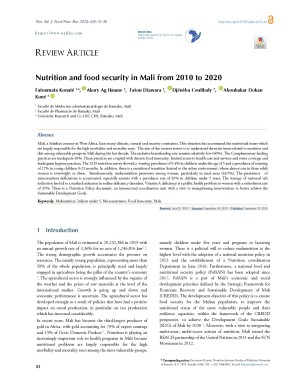
Mali, a Sahelian country in West Africa, faces many climatic, natural and security constraints. This situation has accentuated the nutritional issues which are largely responsible for the high morbidity and mortality rates. The aim of the current review is to understand the main issues related to nutrition and diet among vulnerable groups in Mali during the last decade. The exclusive breastfeeding rate remains relatively low (40%). The Complementary feeding practices are inadequate 49%. These practices are coupled with chronic food insecurity, limited access to health care and services and water coverage and inadequate hygiene practices. The 2019 nutrition survey showed a wasting prevalence of 9.4% in children under the age of 5 and a prevalence of stunting of 27% in young children 0-23 months. In addition, there is a nutritional transition limited to the urban environment, where almost one in three adult women is overweight or obese. Simultaneously, undernutrition perseveres among women, particularly in rural areas (18.5%). The persistence of micronutrient deficiencies is accentuated, especially anemia with a prevalence rate of 82% in children under 5 years. The strategy of universal salt iodization has led to a marked reduction in iodine deficiency disorders. Vitamin A deficiency is a public health problem in women with a retinolemia rate of 35%. There is a Nutrition Policy document, an intersectoral coordination unit with a view to strengthening interventions to better achieve the Sustainable Development Goals.
Keywords
How to Cite
1. United Nations Development Programme (UNDP). Human Development Index Report 2019. Available at URL address: http://hdr.undp.org/sites/default/files/hdr2019.pdf
2. Report from the CREDD Unit (Strategic Economic Recovery Framework for Sustainable. https://www.maliapd.org/wp-content/uploads/2019/07/Version-Finale-CREDD-2019-2023.pdf
3. Profil Nutritionnel des pays. République du Mali. 2010. Available at URL address: http://www.fao.org/3/a-bc634f.pdf
4. World Food Program (WFP) Report: National Survey on Food and Nutritional Security, (ENSAN) Mali) October 2018. Available at URL address: https://www.wfp.org/publications/mali-enquete-nationale-sur-la-securite-alimentaire-et-nutritionnelle-ensan-mali-septembre-20
5. World Food Program (WFP) Report: National Survey on Food and Nutrition Safety, (ENSAN Mali) March 2016. Available at URL address: https://www.wfp.org/publications/mali-enquete-nationale-sur-la-securite-alimentaire-et-nutritionnelle-ensan-march-2016.
6. Tounkara M., Diarra S., Maiga O., Sangare H., Diawara S.I., Diawara F. Sangho H., Iknane A. Ag., Doumbia S. Food Security in Mali: Desk Review. United States Agency for International Development (USAID). December 20189. Available at URL address: https://www.rtachesn.org/wp-content/uploads/2019/12/Food-Security-Desk-Review_ENGLISH_Final_508-1.pdf
7. Mali Demographic and Health Survey. La sixième Enquête Démographique et de Santé du Mali (EDSM VI) 2018. Institut National de la Statistique (INSTAT) 2019. Available at URL address: https://microdata.worldbank.org/index.php/catalog/3526/pdf-documentation
8. Cellule de Planification et de Statistique du secteur santé, développement social et la promotion de la famille (CPS/SSDSPF), Institut National de la Statistique (INSTAT), Enquête par Grappes à Indicateurs Multiples 2009 - 2010, Rapport final, Bamako Mali, 2011.
9. Cellule de Planification et de Statistique du secteur santé, développement social et la promotion de la famille (CPS/SSDSPF), Annuaire Statistique du Système National d’Information Sanitaire du Mali, Rapport final, Bamako Mali, 2019.
10. World Health Organization. WHO report. Nutrition Lands cape Information System (NLIS), country profile indicators: interpretation guide; 2010. Available at URL address: https://apps.who.int/iris/bitstream/handle/10665/44397/9789241599955_eng.pdf?sequence=1
Similar Articles
- An Overview on the Nutrition Transition and Its Health Implications: Tunisia Case
- An Update of the Nutritional Situation in Eastern Algeria
- A review of traditional grain-based complementary foods for children aged 6-23 months in selected African countries
- Zero Hunger and Malnutrition in the African Continent is Potentially Feasible, if Nutrition Programs Are Prioritized Politically and Scientifically
- Update of the Nutritional Situation in the Benin Republic
- Update of the Nutritional Situation in the Republic of Sudan
- Nutrition in Contemporary Zimbabwe: A Situational Analysis
- Update of the Nutrition Situation in Nigeria
- Risk Factors Associated with Severe Acute Malnutrition (SAM) in Children Aged 6 – 59 Months in the Mokolo Health District, Far North Region of Cameroon
- Nutrition Situation of Burkina Faso: A Narrative Review
You may also start an advanced similarity search for this article.

 NAJFNR is licensed under