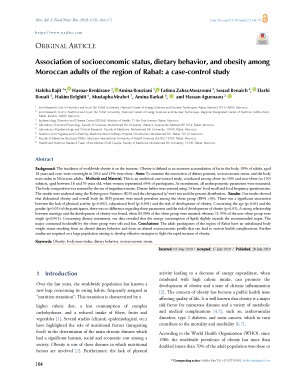
Association of socioeconomic status, dietary behavior and obesity among Moroccan adults of the region of Rabat: A case-control study
Copyright © 2019 Authors

This work is licensed under a Creative Commons Attribution 4.0 International License.
- Attribution — You must give appropriate credit, provide a link to the license, and indicate if changes were made.
- No additional restrictions — You may not apply legal terms or technological measures that legally restrict others from doing anything the license permits.


Background: The incidence of worldwide obesity is on the increase. It is defined as an excessive accumulation of fat in the body. 39% of adults aged 18 years and over were overweight in 2016 and 13% were obese. Aims: To examine the association of dietary patterns, socioeconomic status and the body mass index in Moroccan adults. Methods and Material: This is an analytical case-control study, conducted among obese (n=100) and non-obese (n=150) subjects, aged between 18 and 59 years old, or women represented 60% of participants. At recruitment, all anthropometric parameters were measured. Also the body composition, was assessed by the use of impedance meter. Data concerning the dietary habits was assessed by 24 hours food recall and by food frequency questionnaire. The results were analyzed using the Kolmogorov-Smirnov (K-S) and the chi-squared (χ2-test) test and the percent distribution. Results: Our results showed that abdominal obesity and overall body fat (BF) percent were much prevalent among obese group (BF% >30). There was a significant association between the lack of physical activity (P=0.002), educational level (P=0.001) and the risk of development of obesity. Concerning the age (P=0.06) and the gender (P>0.05) of the participants, there was no difference regarding these parameters and the risk of development of obesity (P>0.05). Another point is the strong association of marriage and the development of obesity, or 83.90% of the obese group were married, whereas 73.70% of the non-obese group were single (P<0.001). For the dietary assessment, our data revealed that the energy consumption of lipids slightly exceed the recommended target and the major consumed products by the obese group were oils and fats. Conclusions: The adult participants of the region of Rabat have an unbalanced weight status resulting from an altered dietary behavior and from an altered socioeconomic profile which can lead to various health complications. The need of more studies in a large population is preferable for the development of effective strategies to combat the problem of obesity.
Keywords
How to Cite
Similar Articles
- Calcium status in Moroccan children and adolescents assessed by 24-hour urinary excretion
- Nutrition situation of Burkina Faso: a narrative review
- Impact of care group participation on nutrition knowledge, behaviour and practices
- Nutritional status of school-age children and adolescents in eastern and southern Africa: A scoping review
- Update of the nutritional situation in Benin Republic
- The role of nutrition in strengthening immune system against newly emerging viral diseases: case of SARS-CoV-2
- Assessment of vitamin A levels in breast milk and serum of lactating mothers in Southeast Nigeria
- Update of the Nutrition Situation in Nigeria
- Traditional cereals-based foods in North African cuisine: Wheat as the cornerstone
- Visualization of nutrient-related clinical practice guidelines in childhood
You may also start an advanced similarity search for this article.
Most read articles by the same author(s)
- Diet, weight status, and physical activity in cancer prevention
- Acceptance of salt reduction in bakery bread among Moroccan consumers
- Nutritional Status, Muscle Mass, and Body Fat Percentage in Patients with Breast Cancer Undergoing Adjuvant Chemotherapy
- Calcium status in Moroccan children and adolescents assessed by 24-hour urinary excretion
- Hypertension in Moroccan adults: sociodemographic, lifestyle, and dietary risk factors
- Household Knowledge of Iodized Salt and Iodine Content of Dietary Salt in Morocco Further 25 Years of Universal Salt Iodization: A National Cross-Sectional Study

 NAJFNR is licensed under