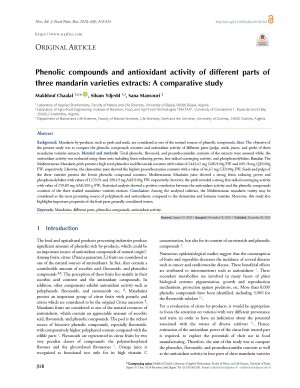
Phenolic Compounds and Antioxidant Activity of Different Parts of Three Mandarin Varieties Extracts: A Comparative Study
Copyright © 2020 Authors

This work is licensed under a Creative Commons Attribution 4.0 International License.
- Attribution — You must give appropriate credit, provide a link to the license, and indicate if changes were made.
- No additional restrictions — You may not apply legal terms or technological measures that legally restrict others from doing anything the license permits.





Background: Mandarin by-products, such as peels and seeds, are considered as one of the naturel source of phenolic compounds.
Aim: The objective of the present study was to compare the phenolic compounds contents and antioxidant activity of different parts (pulps, seeds, juices, and peels) of three mandarins varieties extracts.
Material and methods: Total phenolic, flavonoid, and proanthocyanidin contents of the extracts were assessed while, the antioxidant activity was evaluated using three tests including ferric reducing power, free radical scavenging activity, and phosphomolybdate.
Results: The Mediterranean Mandarin peels present a high total phenolics and flavonoids contents with values of 2445.62 mg GAE/100g FW and 609.78 mg QE/100g FW, respectively. Likewise, the clementine juice showed the highest proanthocyanins contents with value of 46.67 mg CE/100g FW. Seeds and pulps of the three varieties present the lowest phenolic compound contents. Mediterranean Mandarin juice showed a strong ferric reducing power and phosphomolybdate with values of 1270.91 and 190.19 mg AAE/100g FW, respectively, however, the peels reveled a strong free radical scavenging activity with value of 259.89 mg AAE/100 g FW. Statistical analysis showed a positive correlation between the antioxidant activity and the phenolic compounds contents of the three studied mandarins varieties extracts.
Conclusion: Among the analyzed cultivars, Mediterranean mandarin variety may be considered as the most promising source of polyphenols and antioxidants, compared to the clementine and Satsuma varieties. Moreover, this study also highlights important properties of the fruit parts generally considered wastes.
Keywords
How to Cite
1. Russo, M., Fanali, C., Tripodo, G., Dugo, P., Muleo, R., Dugo, L., De Gara, L., & Mondello, L. (2018). Analysis of phenolic compounds in different parts of pomegranate (Punica granatum) fruit by HPLC-PDA-ESI/MS and evaluation of their antioxidant activity: application to different Italian varieties. Analytical and Bioanalytical Chemistry, 410 (15), 3507–3520. https://doi.org/10.1007/s00216-018-0854-8
2. Al-Juhaimi FY., & Ghafoor K. (2013). Bioactive compounds, antioxidant and physico-chemical properties of juice from lemon, mandarin and orange fruits cultivated in Saudi Arabia. Pakistan Journal of Botany, 45, 1193–1196.
3. Jayaprakasha, G. K., & Patil, B. S. (2007). In vitro evaluation of the antioxidant activities in fruit extracts from citron and blood orange. Food Chemistry, 101 (1), 410–418. https://doi.org/10.1016/j.foodchem.2005.12.038
4. Rock, E., & Fardet, A. (2014). Les antioxydants des agrumes : action en solitaire ou matricielle? Phytothérapie, 12 (2), 66–75. https://doi.org/10.1007/s10298-014-0852-8
5. Goldenberg, L., Yaniv, Y., Porat, R., & Carmi, N. (2017). Mandarin fruit quality: a review. Journal of the Science of Food and Agriculture, 98 (1), 18–26. https://doi.org/10.1002/jsfa.8495
6. Prasad, K. N., Chew, L. Y., Khoo, H. E., Kong, K. W., Azlan, A., & Ismail, A. (2010). Antioxidant Capacities of Peel, Pulp, and Seed Fractions of Canarium odontophyllum Miq. Fruit. Journal of Biomedicine and Biotechnology, 2010, 1–8. https://doi.org/10.1155/2010/871379
7. Bocco, A., Cuvelier, M. E., Richard, H., & Berset, C. (1998). Antioxidant Activity and Phenolic Composition of Citrus Peel and Seed Extracts. Journal of Agricultural and Food Chemistry, 46 (6), 2123–2129. https://doi.org/10.1021/jf9709562
8. Martí, N., Mena, P., Cánovas, J. A., Micol, V., & Saura, D. (2009). Vitamin C and the Role of Citrus Juices as Functional Food. Natural Product Communications, 4 (5), 1934578X0900400. https://doi.org/10.1177/1934578x0900400506
9. Scalbert, A., Morand, C., Manach, C., & Rémésy, C. (2002). Absorption and metabolism of polyphenols in the gut and impact on health. Biomedicine & Pharmacotherapy, 56 (6), 276–282. https://doi.org/10.1016/s0753-3322(02)00205-6
10. Martin, S., & Andriantsitohaina, R. (2002). Mécanismes de la protection cardiaque et vasculaire des polyphénols au niveau de l’endothélium. Annales de Cardiologie et d’Angéiologie, 51 (6), 304–315. https://doi.org/10.1016/s0003-3928(02)00138-5
Similar Articles
- Viability of Lactic Acid Bacteria in Different Components of Ogi with Anti Diarrhoeagenic E. coli Activities
- Effect of Healthy Lifestyle Promotion on Anthropometric Variables, Eating Behavior and Cardiometabolic Risk Factors in Women with Polycystic Ovarian Syndrome
- Comparison of Lifestyle Patterns and Body Weight Management Practices Between Normal Weight and Obese Female University Students (Riyadh – Saudi Arabia)
- Effect of Citric Acid and Brine Pre-Treatment on Deodorization of Green Banana Flour
- Association of Socioeconomic Status, Dietary Behavior, and Obesity Among Moroccan Adults of the Region of Rabat: A Case-Control Study
- Rapid Survey on Lifestyle Changes and Body Weight Gain Among Algerians During COVID-19 Lockdown
You may also start an advanced similarity search for this article.

 NAJFNR is licensed under