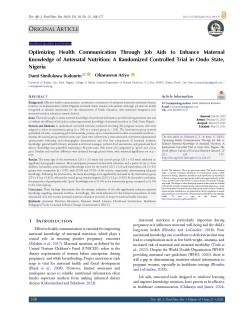
Optimizing Health Communication Through Job Aids to Enhance Maternal Knowledge of Antenatal Nutrition: A Randomized Controlled Trial in Ondo State, Nigeria
Copyright © 2026 Dami Similoluwa Bodunrin, Oluwaseun Ariyo

This work is licensed under a Creative Commons Attribution 4.0 International License.
- Attribution — You must give appropriate credit, provide a link to the license, and indicate if changes were made.
- No additional restrictions — You may not apply legal terms or technological measures that legally restrict others from doing anything the license permits.





Background: Effective health communication constitutes a cornerstone of enhanced maternal nutritional literacy; however, its implementation within Nigerian antenatal clinics remains sub-optimal. Although job aids are widely recognized as valuable instruments for the enhancement of health education, their systematic integration into antenatal nutrition education remains limited.
Aims: This study sought to assess maternal knowledge of nutritional information provided during antenatal care and to evaluate the efficacy of job aids in enhancing maternal knowledge of antenatal nutrition in Ondo State, Nigeria.
Patients and Methods: A randomized controlled trial was conducted involving 200 pregnant women, who were assigned to either an intervention group (n = 100) or a control group (n = 100). The intervention group received specialized job aids—comprising pictorial materials, posters, and a comprehensive booklet on antenatal nutrition—whereas the control group received routine care. Data were collected via a semi-structured, interviewer-administered questionnaire evaluating socio-demographic characteristics and four key components of antenatal nutrition knowledge: general health literacy, antenatal nutritional messages, nutrient-food associations, and gestational food taboos. Knowledge was quantified employing a 40-point scale, with scores ≥23 categorized as "good" and <23 as poor. Baseline and end-line difference were analyzed through paired t-tests, with statistical significance set at p < 0.05.
Results: The mean ages of the intervention (29.0 ± 3.9 years) and control groups (28.1 ± 4.5 years) exhibited no significant demographic variance. Most participants possessed tertiary-level education and a parity of one to three children. At baseline, mean nutritional knowledge scores for the control (23.1 ± 3.6) and intervention (23.6 ± 4.9) groups were comparable (p > 0.05), with 60.0% and 57.0% of the cohorts, respectively, demonstrating adequate knowledge. Following the intervention, the mean knowledge score significantly increased in the intervention group (27.9 ± 4.3; p < 0.001), whereas the control group remains stagnant (23.0 ± 5.2; p = 0.410). By the study’s conclusion, the proportion of participants with "good" knowledge rose to 91.8% in the intervention group, compared to 61.0% in the control group.
Conclusion: These findings demonstrate that the strategic utilization of job aids significantly enhances maternal knowledge regarding antenatal nutrition. Accordingly, this study advocates for the formal incorporation of such educational tools into routine antenatal nutrition education protocols to improve maternal health outcomes.
Keywords
How to Cite
Agarwal, S., Lasway, C., L'Engle, K., Homan, R., Layer, E., Ollis, S., Braun, R., Silas, L., Mwakibete, A., & Kudrati, M. (2016). Family planning counseling in your pocket: A mobile job aid for community health workers in Tanzania. Global Health: Science and Practice, 4(2), 300–310. https://doi.org/10.9745/GHSP-D-15-00393 DOI: https://doi.org/10.9745/GHSP-D-15-00393
Akeredolu, I. A., Osisanya, J. O., Okafor, J. C., & Seriki-Mosadolorun, J. (2013). Pregnancy outcomes of women in Lagos state: Is nutrition education responsible? Pakistan Journal of Nutrition, 13(1), 7–11. https://doi.org/10.3923/pjn.2014.7.11 DOI: https://doi.org/10.3923/pjn.2014.7.11
Al-Ateeq, M., & Al-Rusaiess, A. (2015). Health education during antenatal care: The need for more. International Journal of Women's Health, 7, 239–242. https://doi.org/10.2147/IJWH.S75164 DOI: https://doi.org/10.2147/IJWH.S75164
Barbieri, M. D., Blumberg, J., Dewey, K. G., Erick, M., Hanrahan, J., Hoffman, D., Luke, B., McManus, K., Redfern, J., Walker, W. A., & Willet, W. (2012). The pregnancy food guide. Brigham and Women's Hospital. https://www.brighamandwomens.org/assets/bwh/obgyn/pdfs/nob-bwh-pregnancy-food-guide.pdf
Baruwa, S., Tobey, E., Okafor, E., Afolabi, K., Akomolafe, T. O., Ubuane, I., Anyanti, J., & Jain, A. (2022). The role of job aids in supporting task sharing family planning services to community pharmacists and patent proprietary medicine vendors in Kaduna and Lagos, Nigeria. BMC Health Services Research, 22(1), 981. https://doi.org/10.1186/s12913-022-08360-0 DOI: https://doi.org/10.1186/s12913-022-08360-0
Billah, S. M., Ferdous, T. E., Siddique, A. B., Raynes-Greenow, C., Kelly, P., Choudhury, N., Ahmed, T., Gillespie, S., Hoddinott, J., Haider, R., Menon, P., El Arifeen, S., & Dibley, M. J. (2022). The effect of electronic job aid assisted one-to-one counselling to support exclusive breastfeeding among 0–5-month-old infants in rural Bangladesh. Maternal & Child Nutrition, 18(3), e13377. https://doi.org/10.1111/mcn.13377 DOI: https://doi.org/10.1111/mcn.13377
Black, R. E., Allen, L. H., Bhutta, Z. A., & Maternal and Child Undernutrition Study Group. (2008). Maternal and child undernutrition: Global and regional exposures and health consequences. The Lancet, 371(9608), 243–260. https://doi.org/10.1016/S0140-6736(07)61690-0 DOI: https://doi.org/10.1016/S0140-6736(07)61690-0
Blondin, J. H., & LoGiudice, J. A. (2018). Pregnant women's knowledge and awareness of nutrition. Applied Nursing Research, 39, 167–174. https://doi.org/10.1016/j.apnr.2017.11.020 DOI: https://doi.org/10.1016/j.apnr.2017.11.020
Carroli, G., Rooney, C., & Villar, J. (2001). How effective is antenatal care in preventing maternal mortality and serious morbidity? An overview of the evidence. Paediatric and Perinatal Epidemiology, 15(Suppl. 1), 1–42. https://doi.org/10.1046/j.1365-3016.2001.0150s1001.x DOI: https://doi.org/10.1046/j.1365-3016.2001.0150s1001.x
Chikanya, V. K., & James, S. (2024). Development and validation of a job aid: Tool to reduce infections in home-based stroke. African Journal of Primary Health Care & Family Medicine, 16(1), e1–e9. https://doi.org/10.4102/phcfm.v16i1.4221 DOI: https://doi.org/10.4102/PHCFM.v16i1.4221
Similar Articles
- Anthropometric, Dietary, and Nutritional Outcomes of Vegetarian and Vegan Diets in Childhood: A Narrative Review and Recommendations for Adequate Nutrition
- Nutritional Quality Assessment and Dietary Diversity of Food in Collective Catering: A Study in Al Hoceima Province, Morocco
- Update of the Nutritional Situation in the Benin Republic
- Socioeconomic and Demographic Correlates of Nutritional Status in Elderly Urban Dwellers of Havana, Cuba
- Update of the Nutrition Situation in Nigeria
- Assessment of Dietary Habits, Lifestyle Factors and Circulating Trimethylamine N-oxide Status in Moroccan Colorectal Cancer Patients: A Cross-Sectional Study
- Relationship Between Dietary Habits and Cardiovascular Disease Risk Factors Among Commercial Drivers in Northeast Nigeria
- Association of Socioeconomic Status, Dietary Behavior, and Obesity Among Moroccan Adults of the Region of Rabat: A Case-Control Study
- Quality of life, perceived stress and nutrition of patients with irritable bowel syndrome: A descriptive study
- Association between dietary patterns and lipid profile of older adults in Kogi State, Nigeria
You may also start an advanced similarity search for this article.

 NAJFNR is licensed under